- People
- Expertise
Our expertise
We are a team of more than 600 professionals, with the depth of experience which makes us genuine experts in our fields. Together, gunnercooke’s people have strength across just about every corporate discipline and sector. We provide legal, commercial and strategic advice that delivers real value to the clients we work with, which span from multinational enterprises through to not-for-profit organisations. Our breadth of expertise also covers specialist and emerging disciplines charity, crypto, sports and competition law.
Search by practice areaDispute ResolutionDispute Resolution OverviewMeet the Dispute Resolution TeamIntellectual Property DisputesFinancial Services & FinTech OverviewProceeds of CrimeEmployment TribunalTax InvestigationProperty Dispute ResolutionInsolvency DisputesMediationCivil Fraud & Asset TracingHealth & SafetyBusiness Crime & InvestigationsLitigation & ArbitrationInternational Arbitration - International
International Offices
The gunnercooke group has 16 main global offices across England, Scotland, the US, Germany and Austria, with further plans for growth in the coming years. These offices enhance the existing in-house capability of our dedicated international teams and dual-qualified experts that cover Spain, France, Italy, Portugal, Brazil, China, India, Poland and Hungary. Our team have clients across 126 jurisdictions, speak 46 languages and are dual-qualified in 22 jurisdictions. Our expertise means we can offer large teams to carry out complex cross-border matters for major international clients.
- Our story
Our story
gunnercooke is a top commercial law firm. We comprise a rapidly growing number of experts spanning legal and other disciplines. Clients benefit from flexible options on fees to suit their needs, access to a wider network of senior experts throughout the relationship, and legal advice which is complemented by an understanding of the commercial aspects of running a business.
- Reading Room
- News & Insights
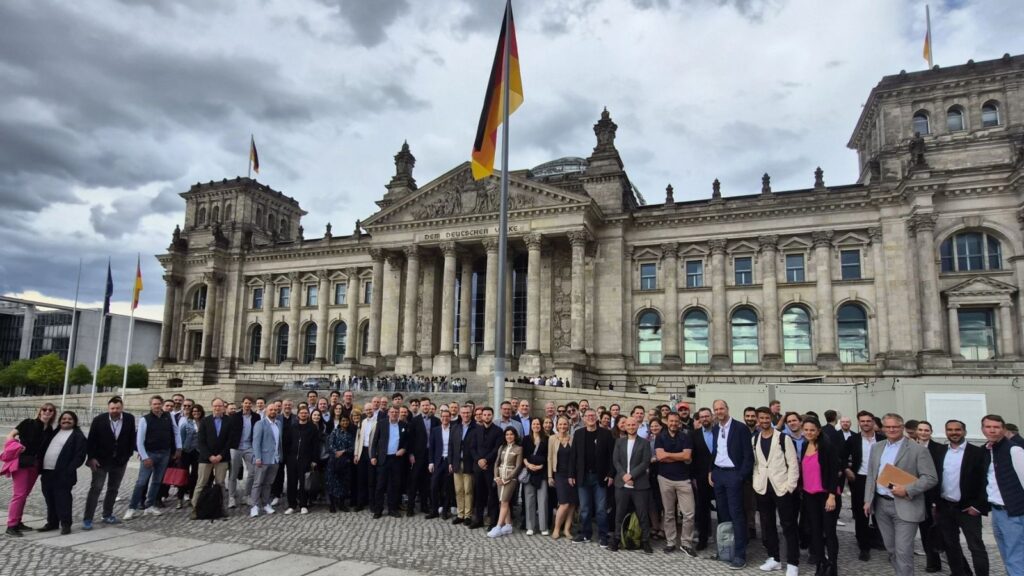
gunnercooke at the 7th Blockchain Roundtable in the German Bundestag: AI & Blockchain as Building Blocks of Digital Sovereignty
Regulatory, Banking & Finance, Capital Markets Partner Dr. Frederik von Essen recently took part in the 7th Blockchain Roundtable, held within the German parliamentary buildings, the “Reichstag”, in Berlin.
Hosted by the Blockchain Bundesverband (Bundesblock) and Member of the Bundestag Marvin Schulz (CDU), the event convened under the theme “AI & Blockchain: Building Blocks of Digital Sovereignty.”
Now an established forum at the intersection of technology, law and policy, the roundtable brings together founders, regulators, academics and industry leaders to exchange views on the developments shaping Europe’s digital and financial infrastructure. This edition brought together more than 200 selected experts.
The programme opened with a keynote from Prof. Dr. Thomas Fürstner (RDDL Foundation), who argued that AI is moving off the screen and into the physical world, from drones to industrial systems, and that this shift creates an urgent accountability problem.
As AI systems begin to act in the world, the central question is no longer whether they are “intelligent” but whether their actions remain attributable. His proposition: blockchain, understood not as speculation but as public infrastructure for identity, signatures, timestamping and tamper-proof provenance, may be the layer that keeps machine activity verifiable and democratically accountable. Sebastian Borek (High-Tech Gründerfonds) followed with an investor’s perspective on the pace of AI development and the emerging role of agent-to-agent payments, identity and governance on-chain.
Two panel discussions developed these themes further.
Panel one: “Digital European Sovereignty: Blockchain and AI Thought Together”
Brought together MdB Marvin Schulz (CDU), Prof. Jens Strüker (Fraunhofer FIT / University of Bayreuth), André Liesenfeld (Microsoft), Patrick Tobler (Masumi Protocol / NMKR) and Antonius Gress (Blockbrain).
Discussion centred on trust infrastructure for an agentic economy: digital identity for both people and machines (“know your agent”), the role of the European Digital Identity Wallet and the forthcoming European Business Wallet, and the emergence of open standards for autonomous agents.
Panel two: – “Payment Solutions for the Age of Agentic AI”
Featured Peter Großkopf (AllUnity), Jan Sell (Qivalis), Dr. Friederike Ernst (Gnosis), Bernhard Schweizer (SAP Digital Currency Hub), Anne-Sophie Gógl (Digital Euro Association / KPMG) and Oliver Naegele (European Public Network / CBMT). The panel examined how AI agents will transact when they hold a wallet rather than a card, and how the European “monetary stack”,MiCAR-regulated e-money tokens, tokenised commercial-bank deposits, and a future digital euro,fits together.
Top takeaways from the event included:
- Accountability for autonomous systems. As AI acts in the physical world, tamper-proof records and machine identity become a practical necessity, not a theoretical concern.
- Agentic payments are arriving now. Stablecoins are emerging as a natural rail for machine-speed, pay-per-use micropayments, supported by open standards and agent identities.
- Interoperability over walled gardens. Sovereignty was framed less as isolation and more as building globally competitive, interoperable infrastructure – with a clear appeal that European solutions remain interoperable with existing settlement networks.
- The monetary stack is complementary. A retail digital euro (expected later this decade and, by design, not programmable), wholesale CBDC, regulated stablecoins and tokenised deposits were seen as serving different, complementary functions.
- Speed and legal clarity are decisive. Participants repeatedly stressed regulatory predictability, the forthcoming MiCAR review, and the need to move from proofs-of-concept to production.
Frederik von Essen commented: “What stood out this year was how directly the conversation has moved from ‘why blockchain’ to ‘how do we make autonomous systems accountable and how do machines pay each other’. For our clients, the practical questions are already here, classifying tokens correctly under MiCAR, structuring compliant stablecoin and payment models, and thinking through identity and liability when an agent acts on a company’s behalf. Europe has a real opportunity, but execution speed and legal certainty will decide whether it leads or follows.”
Need expert advice?
Are you seeking guidance from our Financial Services, FinTech and Crypto team on MiCAR, EMD, PSD, particularly stablecoins, payments or digital assets in general? We would be glad to help, contact Frederik here.
To receive all the latest insights from gunnercooke to your inbox, sign up below